Concepts and vocabulary
For parents and caregivers who want to understand more:
Families often come across words on this website that may feel unfamiliar at first. This page is here to make those ideas easier to understand.
Rather than separate issues, many of the patterns babies show — such as feeding difficulty, tension, gassiness, trouble settling, or sleep disruption — are often connected through how the baby’s nervous system, movement, breathing, digestion, and early coordination are developing together.
This page offers simple explanations for some of the concepts and vocabulary used throughout this website.
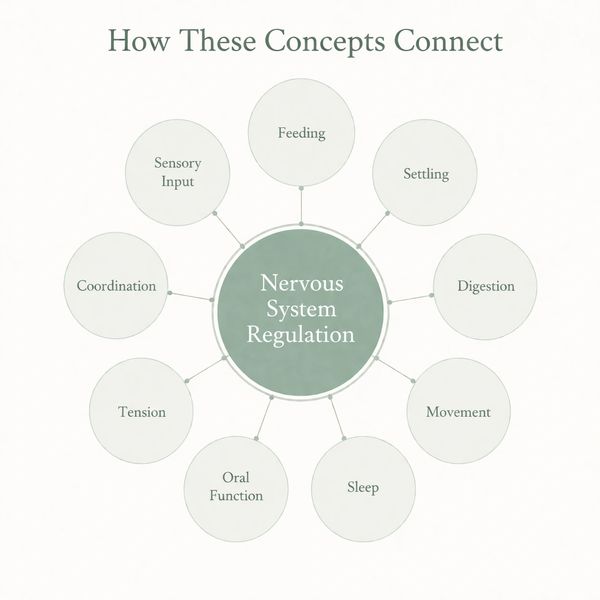
You do not need to learn all of these terms in order to understand your baby. Sometimes the most helpful place to begin is not with vocabulary, but with careful observation:
- How is your baby feeding?
- How is your baby settling?
- How is your baby moving?
- Where does your baby seem comfortable, and where do they seem to work harder?
These questions often tell us more than labels alone. These definitions are here simply to make the language on this website feel more clear and accessible.
Some words describe anatomy.
Some describe feeding function.
Some describe how a baby’s nervous system organizes in early life.
All of them are meant to support understanding — not overwhelm it.
ANKYLOGLOSSIA / TONGUE TIE
Ankyloglossia is the medical term often used to describe what is commonly called tongue tie.
It refers to a variation in the tissue beneath the tongue that may influence how freely the tongue can move.
Not every baby with a tongue tie needs intervention, and not every feeding issue is caused by a tie alone. What matters most is how feeding is functioning.
ASYMMETRY
Asymmetry means that one side of the body may be moving, turning, or organizing differently than the other.
In babies, mild asymmetry can be common, especially early on.
Sometimes it reflects positioning in the womb, birth adaptation, muscle tension, or developing movement patterns.
AUTONOMIC NERVOUS SYSTEM
The autonomic nervous system helps regulate automatic body functions such as breathing, digestion, heart rate, and transitions between activation and rest.
In babies, this system is still developing.
That is one reason babies may seem easily overwhelmed, hard to settle, or variable from one moment to the next.
BABY-LED
Baby-led means the session follows the baby’s cues, pace, and capacity.
There is no expectation that a baby remain still, calm, or “perform” in any way.
Feeding, crying, resting, moving, or pausing are all welcome parts of a session.
BODYWORK
Infant bodywork refers to gentle, hands-on support that pays attention to how a baby is feeling, organizing, and functioning in their body.
This work is not about forceful correction. It is about observing carefully, listening to the baby’s responses, and supporting more comfort, coordination, and ease over time.
CAPACITY
Capacity refers to how much a baby’s system can comfortably manage a given moment.
This may include touch, feeding, movement, stimulation, or change.
When a baby has more capacity, they are often able to stay more settled, organized, and responsive.
When capacity is lower, they may tire more easily, become overwhelmed more quickly, or need more pauses and support.
COLLABORATIVE CARE
Collaborative care means that support may involve more than one provider.
Depending on what is going on, a baby may benefit from care that includes an IBCLC, pediatric dentist, ENT, occupational therapist, feeding therapist, pediatrician, or bodyworker.
The goal is not for one provider to do everything. It is for care to be thoughtful, coordinated, and appropriate to the baby’s needs.
Because the palate is part of the larger craniofascial system, its shape and relationship to surrounding structures can influence feeding mechanics.
COMPENSATION
Compensation refers to the way the body adapts when something feels difficult or less efficient.
For example, if feeding coordination is not coming easily, a baby may compensate by using extra jaw tension, body tension, or effort to complete a feed.
Compensation is not necessarily a problem on its own. It is often the body’s way of trying to manage or adapt.
COORDINATION
Coordination is the ability of different parts of the body to work together in a rhythmic and efficient way.
In babies, this is especially important for feeding. Feeding depends on coordination between the tongue, jaw, swallowing reflex, airway, breathing rhythm, and nervous system.
When coordination is immature or strained, a baby may need to work harder during feeding or settling.
CRANIAL NERVES
Cranial nerves are nerves that emerge from the brain and brainstem and help control things like facial movement, swallowing, tongue movement, sucking, breathing, and digestion.
Several cranial nerves are involved in infant feeding.
When feeding is coordinated, these nerves are doing their work together in a rhythmic and organized way.
CRANIOSACRAL SUPPORT
Craniosacral support is a gentle form of bodywork that pays attention to the relationships between the head, spine, nervous system, and surrounding tissues.
In infants, this work is very light and baby-led. It is often used to support regulation, comfort, feeding coordination, and greater ease in the body.
DISORGANIZED
Disorganized means a baby’s systems are not working together as smoothly in that moment.
This may show up as feeding difficulty, trouble settling, body tension, startle, overwhelm, or difficulty moving between awake and restful states.
It does not necessarily mean something is wrong — often it means the baby is still developing or under strain.
Early development
Early development refers to the rapid growth and organization that takes place during infancy as a baby’s body and nervous system learn to function together with increasing ease.
This includes feeding, digestion, movement, sleep, sensory processing, regulation, and the gradual development of more coordinated patterns over time.
In this context, early development is not only about milestones. It is also about how a baby is adapting, organizing, and becoming more comfortable in their body from the beginning.
Feeding coordination
Feeding coordination refers to how well the structures and reflexes involved in feeding are working together.
This includes sucking, swallowing, breathing, tongue movement, jaw movement, and airway protection.
When feeding coordination is more organized, feeding often feels smoother and less effortful.
FLOOR OF THE MOUTH
The floor of the mouth is the soft tissue area beneath the tongue.
It contains muscles that help support tongue movement, jaw mechanics, and swallowing coordination.
If there is increased tension in this area, a baby may have more difficulty with tongue elevation, latch, or feeding comfort.
Function
Function refers to how something is working, not just how it looks.
In babies, function often matters more than appearance alone. A structure may look typical, but a baby may still be having difficulty with feeding, settling, movement, or coordination.
Looking at function means paying attention to how the body is actually working in real life.
HYOID BONE
The hyoid is a small bone beneath the tongue that serves as an attachment point for muscles involved in tongue movement, jaw opening, swallowing, and airway protection.
Although small, it is part of an important coordination system in feeding.
Immature
In this context, immature means still developing. It does not mean something is wrong.
In early infancy, many systems are not yet fully coordinated, efficient, or stable, which is a normal part of development.
Integration
Integration refers to the process of different systems gradually working together in a more organized and mature way over time.
This is part of normal development.
As babies grow, feeding, movement, reflexes, sleep, digestion, and sensory responses often become more coordinated through integration.
LATCH
Latch refers to how a baby takes the breast or bottle into the mouth and creates the seal needed for feeding.
A comfortable latch often depends on lip seal, tongue movement, jaw opening, positioning, and overall feeding coordination.
Difficulty with latch can reflect many things, including tension, oral restriction, immaturity, or difficulty organizing for feeding.
Mature
In this context, mature means more fully developed , coordinated, and stable over time.
A more mature system often functions with greater ease, efficiency, and consistency.
In babies, this may show up in feeding, settling, movement, and transitions between states.
MILK TRANSFER
Milk transfer refers to how effectively a baby moves milk from the breast or bottle into their body.
Milk transfer depends on latch, tongue movement, jaw rhythm, suction, swallowing, breathing, and endurance.
A baby may latch but still have challenges with milk transfer if the deeper feeding mechanics are not coordinating well.
NERVOUS SYSTEM REGULATION
Nervous system regulation refers to how well a baby is able to take in sensory input, respond to the world, and return to a more settled state.
In babies, regulation is not simply about being calm. It includes how a baby feeds, rests, digests, moves, responds to touch, and transitions between awake and settled states.
When a baby’s system is more regulated, feeding, sleep, movement, and comfort often become easier to organize.
ORAL FUNCTION
Oral function refers to how the structures of the mouth are working together during feeding.
This includes the lips, cheeks, tongue, jaw, palate, floor of the mouth, swallowing structures, and airway.
A baby may have normal-looking anatomy but still need support with oral function if the structures are not coordinating easily.
ORAL RESTRICTION
Oral restriction refers to tissue that may limit the movement of structures in the mouth, such as the tongue, cheeks, or lips.
Tongue tie is one example of oral restriction.
Restriction is only one part of the picture. Function, coordination, and comfort during feeding also matter.
ORGANIZATION
Organization refers to how well different systems in the body are working together.
In early infancy, this may include how breathing, sucking, swallowing, posture, muscle tone, digestion, and settling are coordinating.
When a baby is well organized, feeding and movement often feel smoother and less effortful.
PALATE
The palate is the roof of the mouth.
It provides a surface against which the tongue works during feeding and plays an important role in suction, swallowing, and oral coordination.
Because the palate is part of the larger craniofacial system, its shape and relationship to surrounding structures can influence feeding mechanics.
POSTURAL ORGANIZATION
Postural organization refers to how a baby holds and coordinates their body against gravity.
This affects feeding, head turning, comfort in different positions, early motor development, and the ability to settle.
When posture is more organized, babies often move and feed with greater ease.
PRIMITIVE REFLEXES
Primitive reflexes are early reflexes present in infancy that support survival, protection, feeding, and development.
Over time, as the nervous system matures, these reflexes gradually integrate and make room for more voluntary control.
Primitive reflexes are not automatically a problem. They are one part of understanding how a baby is organizing.
REFLEX
A reflex is an automatic response that happens without conscious effort.
In infancy, reflexes help support early survival and development.
Examples include rooting, sucking, grasping, and startle responses.
Reflexes are normal in newborns and are part of how the nervous system organizes early movement and function.
Restriction
Restriction refers to a limitation in movement or function within a tissue, structure, or system.
In babies, restrictions may influence feeding, comfort, movement, or coordination, depending on where it is present and how the body is adapting around it.
SENSORY INPUT
Sensory input refers to the information a baby receives from touch, movement, sound, light, position, and internal body sensations.
Babies are constantly taking in sensory information.
Regulation involves how well a baby can receive that input, respond to it, and recover from it.
SETTLING
Settling refers to a baby’s ability to move toward rest, ease, or a calmer state.
This may happen during feeding, after feeding, at sleep times, or in response to support from a caregiver.
Difficulty settling does not always mean something is wrong, but it can be part of a larger pattern worth understanding.
STATE
State refers to the condition a baby is in at a given moment, such as deeply asleep, lightly asleep, quietly alert, active, fussy, or crying.
A baby’s state influences how easily they may feed, settle, tolerate handling, or respond to the environment.
Because babies are still learning to move between states, state is an important part of how they function in daily life.
Strain
Strain refers to extra effort, tension, or stress within the body or nervous system.
In babies, strain may appear during feeeding, movement, digestion, or settling.
A baby under strain may seem to work harder, fatigue more easily. , or have less ease in their body.
SUCK–SWALLOW–BREATHE
Suck-swallow-breathe describes the repeating rhythm a baby uses during feeding.
A baby must be able to draw milk into the mouth, swallow it safely, and pause to breathe in a coordinated pattern.
When this rhythm is smooth, feeding is often more comfortable and efficient. When it is strained, feeding may look effortful, noisy, fatiguing, or disorganized.
SYMPTOM
Symptom refers to a sign that something may be bothering a baby or that a system may be under strain.
In babies, symptoms may show up as feeding difficult, tension, discomfort, trouble settling, sleep disruption, grassiness, or changes in behavior.
A symptoms is not always the problem itself. It is often a clue that helps us look more closely at how a baby is functioning overall.
SYSTEM
System refers to a group of parts in the body that work together to carry out a function.
In babies, examples include the nervous system, digestive system, musculoskeletal system, and sensory system. Theses systems do not work in isolation. They influence one another, which is why feeding, settling, movement, digestion, and regulation are often closely connected.
TENSION PATTERN
A tension pattern is an area of increased holding or strain in the body.
In babies, this may show up in the jaw, mouth, neck, shoulders, diaphragm, or body as a whole.
Tension patterns can sometimes influence how a baby feeds, settles, turns their head, lies comfortably, or transitions between states.
VAGUS NERVE
The vagus nerve is one of the major nerves of the autonomic nervous system.
It helps regulate swallowing, digestion, heart rate, and the body’s ability to settle and rest.
Because it is involved in both feeding and regulation, it is often part of the larger picture when babies are having difficulty with feeding, digestion, or settling.
VOLUNTARY MOVEMENT
Voluntary movement refers to movement a baby begins and controls with increasing intention, rather than through an autonomic reflex.
In early infancy, voluntary movement develops gradually as the nervous system matures and the body becomes more organized. This may show up as more purposeful head turning, reaching, bringing the hands to the mouth, or changing position with greater intention.
IMPORTANT NUANCE
These words are meant to support understanding, not create fear. Many babies show periods of tension, feeding effort, gassiness, irregular sleep, or temporary asymmetry as their systems develop.
Not every pattern is a sign of a major problem. What matters most is the whole picture — how a baby is feeding, growing, resting, moving, and responding over time.
If you are concerned about feeding, breathing, muscle tone, development, or comfort, it is important to bring those concerns to your pediatrician. Often, bodywork can be one layer of support within a broader picture of care.
Understanding your baby: understanding infant bodywork
For parents and caregivers interested in learning more about infant bodywork and craniosacral support.
Infant Bodywork & Craniosacral Support | Southern California
In-home visits available in San Diego County, Orange County, and surrounding areas in Southern California by appointment.
Email: hello@rubymlopez.com
Call or Text: (760) 297-6389
Parents are welcome to reach out with questions before scheduling.
Copyright © 2026 Infant Bodywork & Craniosacral Support | Southern California - All Rights Reserved.
This website uses cookies.
We use cookies to analyze website traffic and optimize your website experience. By accepting our use of cookies, your data will be aggregated with all other user data.